Form 41 Filing for Non-Residents: Why Professional Assistance Matters
Created By :
Vikas Sharma
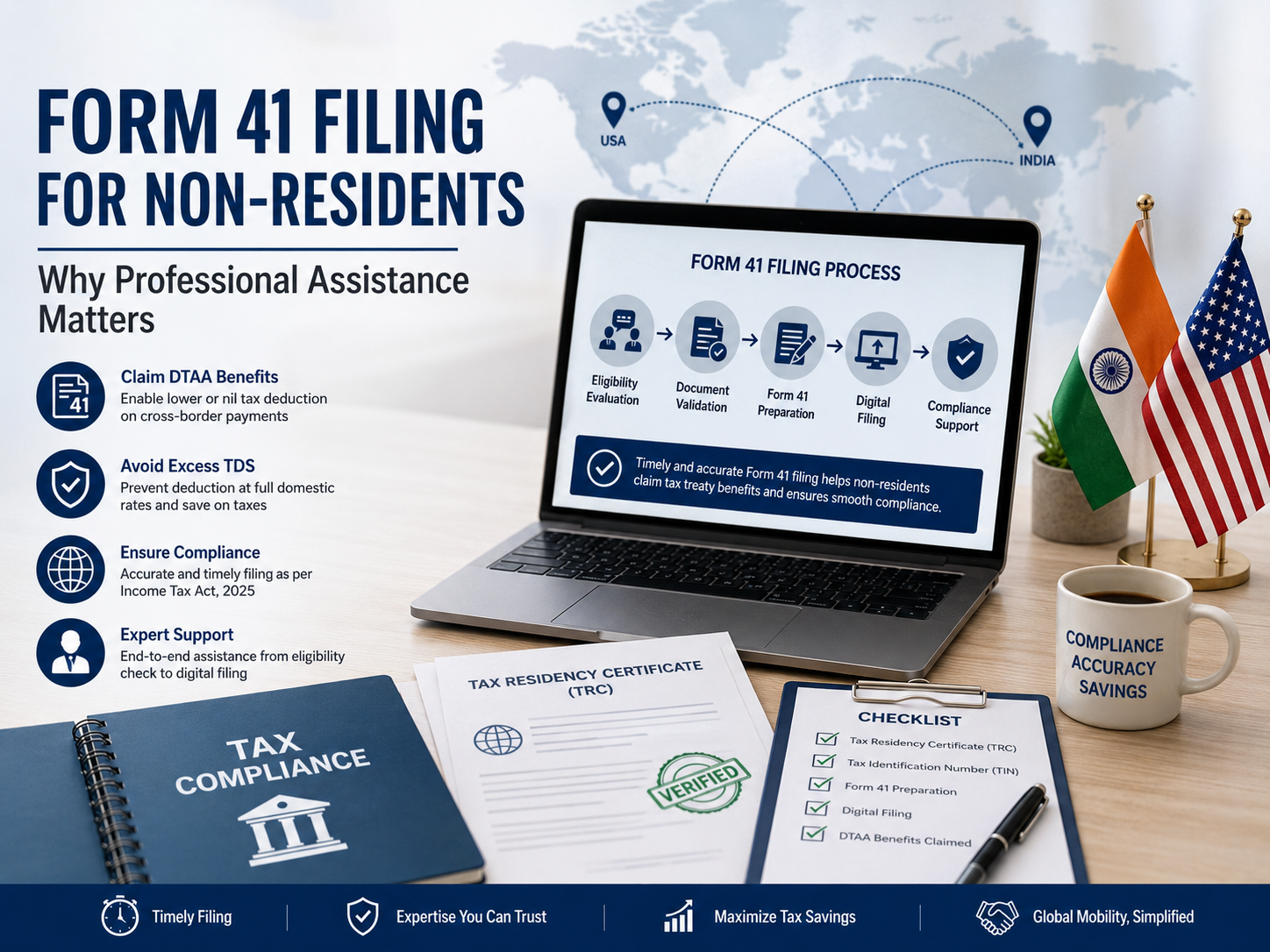
Managing withholding tax (TDS) can be a major headache for non-residents earning income from India, which is why keeping up with Form 41 compliance is extremely important. If the required filings are delayed or incorrectly submitted, Indian payers may be required to deduct tax at full domestic rates, resulting in the loss of applicable treaty benefits and lower withholding rates.
At AKM Global, we help non-resident taxpayers successfully claim Double Taxation Avoidance Agreement (DTAA) benefits by handling the entire Form 41 process accurately and on time.
What is Form 41?
Form 41, which replaces the earlier Form 10F under the new Income Tax Act, is designed for enabling lower or nil tax deduction on cross-border payments. It applies to various taxpayers earning income from India, including:
-
Individuals: This includes foreign citizens working in India, freelancers or consultants providing services remotely, or individuals receiving income from Indian entities.
-
Companies: Foreign companies earning income from India, regardless of whether they have a permanent establishment in the country.
-
Other Entities: This can encompass any non-resident entities like trusts, partnerships, or associations that derive income from India and seek tax treaty benefits.
Timely and accurate filing of Form 41 is crucial because it helps them avoid excess deduction at the withholding stage.
Why Form 41 Filing Requires Professional Attention?
Filing Form 41 involves navigating specific tax frameworks and strict documentation rules. Payers are required to deduct tax at prescribed domestic rates, which are usually higher unless valid treaty documentation is furnished. Without a valid Form 41 and a Tax Residency Certificate (TRC), tax is deducted at full domestic rates, even where DTAA provisions allow an exemption or reduced rate. Navigating the Income-tax Act, 2025, and applying the correct DTAA benefits requires professional precision to ensure no excess deductions occur.
When Should You Hire a Form 41 Consultant?
You should consider hiring a professional consultant for Form 41 compliance in the following key scenarios:
-
When managing cross-border payments where an Indian customer requires valid documentation before processing the transaction.
-
When you are a non-resident seeking to claim tax treaty benefits to prevent TDS from being deducted fully at domestic rates.
-
When you need assistance in evaluating the nature of income against applicable DTAA provisions.
-
When you require digital filing of Form 41 through the Income Tax e-filing portal using PAN-based or non-PAN login.
Key Benefits of Hiring AKM Global for Form 41 Filing
At AKM Global, we follow a structured and compliance-focused approach to ensure accurate and timely Form 41 filing for non-resident taxpayers seeking DTAA benefits in India.
Our step-by-step process / services portfolio typically includes:
-
Initial Evaluation: We conduct an eligibility review, focusing on the evaluation of income type and applicable DTAA provisions.
-
Documentation Support: We assist with validating the Tax Residency Certificate (TRC), Tax Identification Number (TIN), and other supporting details.
-
Form Preparation: We handle the preparation and verification of Form 41 directly at the tax portal.
-
Digital Filing: We manage the submission through the Income Tax e-filing portal using PAN-based or non-PAN login, depending on a case-by-case basis.
-
Compliance Assistance: General assistance in Form 41 Compliance for Non-Residents and Cross-Border Payments.
By ensuring timely and accurate filing of Form 41 along with the required supporting documents, AKM Global enables Indian payers to apply DTAA benefits directly at the withholding stage itself. This helps non-resident taxpayers avoid excess deduction of taxes and reduces the likelihood of refund-related challenges later.
Documents Required for Form 41 Filing
To successfully file Form 41, the following documentation is required:
-
A Tax Residency Certificate (TRC) issued by the tax authority of the country of residence.
-
The TRC confirms the taxpayer's residency status and serves as official proof of residency for the Indian Income Tax Authorities.
-
Tax Identification Number (TIN) allotted to the taxpayer in their country of residence.
Common Mistakes Businesses Make While Filing Form 41
-
Filing Without Prior Eligibility Verification: If an entity is ineligible for tax treaty benefits, TDS must be withheld at the domestic rate. In such cases, filing Form 41 is not required.
-
Missing Supporting Documents: Failure to provide a valid TRC for the relevant period for which Form 41 is required to be filed.
-
Frequency of Filing: Failing to recognise that Form 41 must be filed annually (once per tax year) if a treaty benefit is being claimed during that.
-
Assuming the Form Can Be Corrected Later: Once Form 41 is submitted and the acknowledgement is generated, it generally cannot be edited. In case of an error, a fresh filing is required.
Need assistance with Form 41 filing? AKM Global can help you ensure accurate submission and full compliance. Contact our team today at info@akmglobal.in for professional support or submit your query here.
FAQs
Q1. What is Form 41 and is it mandatory?
Yes, Form 41 is mandatory for non-residents to claim benefits under relevant tax treaties.
Q2. How many times can Form 41 be filed in a year?
Form 41 must be filed annually (once per tax year) by a non-resident when the non-resident is seeking to claim benefits under an applicable tax treaty.
Q3. What happens if Form 41 is not submitted?
If Form 41 is not submitted, the Indian payer is generally required to deduct tax at the rate as per the Income Tax Act, 2025 without granting any benefit under the relevant tax treaties.
Q4. Can I edit Form 41 after submission?
No. Once Form 41 is submitted and an acknowledgment is generated, it cannot be edited. However, if there is a mistake while filing the form, you have to again file a fresh form.
Q5. What are the mandatory documents required to file Form 41?
The mandatory documents required to file Form 41 include a Tax Residency Certificate (TRC) issued by the taxpayer's country of residence, confirming the taxpayer's residency status, and the Tax Identification Number (TIN) assigned to the taxpayer in that country.
Q6. What is a Tax Residency Certificate (TRC)?
The TRC serves as the official proof of residency for the Indian Income Tax Authorities. It is mandatory for non-residents to obtain this certificate from their respective home countries.